June 6, 2026
Friendology Volume 1: A New Perspective on Finding and Sustaining Friends
Friendology Vol 1 will help you understand 3 key principles that will strengthen your friendship efforts and results
By Erik Newton
Outline
I. Research – Making the case for making friends
II. Pillar 1: Friends Should Provide the Bulwark of Your Psychological Stability and Strength
III. Pillar 2: Imprinting – making good friends
IV. Pillar 3: Reciprocation, Priority, Resistance and Friction
V. Friend Definitions – understand progression
VI. Sources – find better people
VII. Future Research: The Reciprocity Hypothesis
VIII. Conclusion
Intro and the Origin of Friendology
Most of us grow up believing friendship should just happen naturally and that the people we are meant to be close to will simply appear and stay. But as adults, life changes: people move, priorities shift, and many of us wake up one day realizing the friendships we counted on are gone, or thinner than we believed. When this happened to me, when I found myself with only one local friend after decades of assuming I had many, I didn’t collapse or make excuses. I chose to look directly at reality. I realized I had been trying to find belonging without knowing how to build it. This is the work I did to change that. Friendology is emotional sovereignty applied to belonging: the ability to stay fully yourself while forming relationships that are mutual, meaningful, and satisfying.
I. Why Make More Local Friends
Former US Surgeon General Vivek Murthy wrote a parting prescription for America in which he addressed the epidemic of loneliness. A major focus of the prescription was more community made up of more local friends.
The average adult man in the US has 1-2 local friends. About 20% of single men have 0 local friends. Women do about twice as well on both metrics. Lack of community decreases life satisfaction, worsens physical and mental health, and shortens lifespan. People with close friends show a 24% reduced risk of mortality and as high as 50%; another study showed people with the most friends outlive the people with the fewest friends by 22%. Having more friends has greater impact on survival than exercise and is comparable to quitting smoking.
More than half the population reports not making a new friend in the last 12 months. 33% of seniors have not made friend in the last 5 years. Most research finds people have childhood friends, work friends, spouses, relatives, and online friends in the friend count, which accentuates the lack of new local in-person friendships being made.
The closer your friends live to you the happier they will help you be. Local (within 1 hour) friends see each other at least 40% more and have about a 40% higher chance of relationship continuity. Distance was also cited as the #1 reason for friend loss in a different study. People report losing almost 1 friend per year. If you don’t replenish them, that number goes to zero.
After reading this, you should be able to recognize and avoid the common misconceptions and mistakes that create friction and disappointment and focus your effort toward the activities and environments where new friends are most likely to develop and sustain.
II. Pillar 1: Friends Should Provide Significant Psychological Stability and Resilience
Structured relationships such as family, marriage, and work are essential pillars of life. They provide attachment, security, continuity, and purpose. Because they are built around enduring roles and responsibilities, they are naturally concentrated in relatively few people and change slowly over time.
Friendships are different. They are lateral relationships built on voluntary participation, shared contribution, and mutual agency. Unlike family or romantic relationships, they are continually renewable and expandable throughout adulthood. A healthy friendship network distributes companionship, ideas, practical support, and opportunity across many people rather than concentrating them in one or two relationships, which creates concentration risk.
Allocating Your Relational Support
Your support infrastructure has four primary pillars: Family, Friends, Romantic Partner, and Self. Within self, you might also include spirituality or faith. Each person builds a different stack depending on environment and circumstance. For example, families with small children will lean that way. New romantic partnerships will lean that way.
– Large-family bias: Family > Partner > Self > Friends
– Independent-upbringing bias: Self > Partner > Friends > Family
– Blended-family bias: Partner > Self > Family > Friends
Each configuration favors what is most available and proximate. Over time and into stable maintenance periods people will probably outgrow them. Families are small and slow to update. Partners are concentrated on one person. The self is a single point of view and point of failure.
Friends, however, form an open system. You choose them. They diversify your inputs, stretch with growth, and replenish through renewal and replacement. Family members who die cannot be replaced; partners can be replaced to a degree with great effort; friends can always be expanding and renewing. The pool is infinite.
Think about an adult child of 34 who lives with his mother and spends most of his social time with her. Or consider a 56-year-old man with few or no friends who is unexpectedly laid off and forced into retirement. Much of his companionship, recreation, and emotional support may now depend almost entirely on his wife. If that marriage later ends through divorce or widowhood, rebuilding a social life can be extraordinarily difficult.
Friendology is a theory of relational architecture. It argues that resilient lives are built on diversified social systems. Family, partners, work, and self are indispensable pillars, but friendship is the only major relationship category that remains broadly renewable and expandable throughout adult life. A healthy lateral friendship network distributes support across many people, making the entire system more adaptable when life inevitably changes.
Structured relationships are concentrated on fewer people, often operate based on roles, and are sometimes asymmetric.
The horizontal network is more robust and diverse with lighter, more flexible roles.
If friendships are the most renewable and expandable category of adult relationship, then they represent one of the greatest opportunities to improve long-term social resilience. You can see how different that would be from what most people are doing now.
That’s why Friendology recommends maintaining roughly 55% of your relational energy in the lateral grid. It’s not about the number of friends or hours spent; it’s about where your nervous system sources additional stability and renewal. Structured bonds tend to keep you safe. Lateral ones can help you expand and thrive.
As a systems logic test, look for the weakness in these allocations:
100% self, no friends, no family, no partner
100% partner, no friends, no family, no self-reliance
100% family, no friends, no partner, no self-reliance
100% friends, no partner, no family, no self
Each architecture reveals a different obvious structural weakness. There is a lot of institutional support for marriage, family, work, and self-development but not much for friends. That shift away from friends is one of the causes of the loneliness epidemic.
Recommended social infrastcuture allocation examples:
55% friends 15% romantic partner 15% self 15% family
In practice that might look like:
8 friends > 4 family > 1 partner > 1 self
For people with grown children or a small or no biological family and less or no work, it might look like:
55% friends 38% romantic partner 7% self
For people with no romantic partner, no biological family, and no work (the case for many senior citizens), friends would need to make up the vast majority of social support and stability.
Friendology argues that resilient lives are built on multiple pillars, but that friendship deserves the largest emphasis because it is the only pillar that remains broadly renewable and expandable throughout adult life.
A strong marriage and a strong friendship network are complements, not substitutes for friendships. Marriage provides stability at the core. Friendship provides resilience, opportunity, and expansion throughout the rest of the system.
When I began applying Friendology, I had just one local friend. Today I have more than a dozen actively contributing local friends, and the effects have reached far beyond my social life. My marriage is steadier. I’m happier and more relaxed. I’ve fallen in love with my humble city of San Jose.
Even my desire to travel has faded because why leave the place where I finally found what I was always looking for, where I literally and figuratively belong?
III. Pillar 2: Friendfulness and Use the Physics of Imprint
When we become close to someone, we don’t just take a place in their life, we occupy a place in their brain, memory, emotional state, and even their body. The nervous system reacts and adapts to close friends. Neural pathways strengthen through repeated, trusted contact. Friends trigger feel-good chemistry — dopamine, serotonin, oxytocin — when they show up and by showing interest and care. That is the evidence of the friendship imprint.
A friendship exists as its own living pattern of charge between two people. It carries memory, safety, and reward, and it flickers brighter or dimmer depending on how it is engaged and nurtured or deprived.
In a very real sense, we build and occupy a neural imprint like a room in their internal world. When we’re absent, that room is empty, and they feel the gap. They think about us. They reach out. They invite us back in. And when we reunite, that neural space lights up again — familiar, comforting, alive. That’s the evidence and proof of being good friends. Healthy friendships contribute massive physical and mental health benefits.
Here is a simple, memorable framework for connecting and accelerating imprinting, I call it the IEEET or I Triple E T. It is the state of being friendful.
I Interest, be genuinely interested in the other person
E Eye contact, connect without glaring or staring
E Empathy, the glue that makes the other 4 work
E Effort/Ears/Engaged listening
T Thanks, appreciate and express appreciation
And while it may seem unclear how we earn and maintain that kind of space, the process is clear: the brain and body encode the imprint of people who matter primarily through 8 pathways and signals: (What gets imprinted). The more we give someone to imprint us, the richer and stronger the imprint.
1. Feelings — positive emotional energy lays the foundation of the friendship imprint
2. Acceptance & validation — being heard and understood deepens emotional safety
3. Trust — consistency and reliability reinforce the imprint and build confidence
4. Images — faces, photos, the visual reminders reinforce memory
5. Words — conversations, texts, and written notes add context and meaning
6. Memories — shared joy, play, laughter, milestones, and challenges populate the imprint
7. Embodied experiences — sports, activities, routines, going to favorite places anchor the imprint in the kinetic body
8. Material generosity — the tangible expressions of care through gifts, meals, and milestone support generate affection and gratitude.
When we do these things well and consistently, we don’t just make connections we imprint and create true friends. The kind who feel our absence. The kind who make sure we don’t stay absent for long. The kind who are worth missing and who miss us back.
When people are rude, selfish, dismissive, judgmental, controlling, or otherwise offensive, they trigger a dopamine crash in the other person. It shows up in the stomach, chest, and brain as cortisol rises and energy drains; we feel sickened, tense, irritated, and tired. The conscious signal of this crash is boredom. We lose interest in talking to them, begin to deimprint, and naturally move on to seek more rewarding company.
Hachiko and Professor Ueno: An Imprinted Bond
In 1924 in Tokyo, Japan Hidesaburō Ueno adopted a male Akita pup he named Hachiko. Each morning, they walked together to Shibuya station where he boarded the train to Tokyo University. Hachiko sat by the gate, watching until the crowd carried him away and then Hachiko walked back home.
Every afternoon, around five o’clock, Hachiko returned ears forward, eyes scanning the same faces. When the train doors opened, his body would lift with joyous recognition, and they would walk home together. One day, the professor died suddenly at the university and never rode the train again. Hachiko continued to go to look for him every day at 5 o’clock for over nine years—roughly 3,000 days of waiting, watching, and walking back without him. Through typhoons, summer heat, and the soft snow of Tokyo winters, he went to pick him up. The commuters came to know him. Some brought scraps of food; others simply nodded or bowed, acknowledging his steadfastness.
The shared rhythm, walk, wait, return, had become Hachiko’s body’s way of keeping love alive in the absence of its source. What began as simple conditioning had deepened into something else—an imprint, where the nervous system itself remembered the bond and kept searching for it long after it was gone.
That’s what imprint feels like between humans too. When the pattern is real, absence doesn’t turn it off it keeps running quietly beneath the surface, a current looking for its circuit. Presence becomes calm. Absence becomes longing. And reunion, when it happens, brings peace and joy.
Hachiko was so loved and admired that after he died, the city cast a bronze statue of him at what’s now called the Hachiko Exit of Shibuya Station. To this day, it remains the most recognizable meeting spot for friends and lovers in all of Japan, a place where people still wait for each other with anticipation and joy, just as Hachiko once did.
Josh and Anton: The New Friend Imprint
Josh and Anton met on the friendship app BFF, both hopeful for a new friend. Their first meetup was tacos at Josh’s favorite spot. Conversation moved easily the kind that skips the résumé stage and drops straight into the rhythm of laughter, pauses, and honest curiosity.
The next time they played pool. Then came a backyard barbecue. Then lunch and after that dinner. Around the third or fourth meeting they both recognized each other as friends.
Anton had moved to San Jose to be closer to his girlfriend, trading a long commute for a short one but leaving his old network behind. Josh had lived in the area for decades, but most of his friends had moved away. They met in that open space where two largely empty social maps overlap and both people are glad they did.
At one point two weeks went by and they hadn’t seen each other—life, work, the usual drift—and Anton felt a pang. He scrolled his phone and thought about texting Josh, then didn’t. He wasn’t lonely exactly; it was subtler than that. He just missed him and didn’t understand why he was missing a new friend. Missing an old friend made sense but why a new one?
Inside him, the chemistry of connection was adjusting—oxytocin, serotonin, dopamine—good mood, calm, happiness had been reinforced each time they met. The body had become conditioned to the presence and now registered its absence. The feeling didn’t seem particularly psychological; it was neurochemical memory looking for its connector.
That’s how imprinting begins between adults through a pattern of shared positive attention strong enough to leave an imprint. The imprint reminds its host that reactivation would be enjoyable.
Technical Sidebar: The Imprint Cycle in Body Chemistry and Immune System
Each strong friendship imprint moves through a repeating chemical loop:
Anticipation (Dopamine) — Curiosity and excitement before meeting.
Engagement (Dopamine+Oxytocin) — Focused attention and joy in interaction.
Safety Signal (Oxytocin + GABA) — Relaxation, trust, and openness emerge.
Stabilization (Serotonin + Endorphins) — The friendship feels “real” and enduring.
Memory Encoding (Hippocampus) — Neural imprint locks in, enabling future recall and reactivation.
This loop explains the feeling of a connection that clicks and make a person feel connected, happy, and calm.
The immune system is strengthened every time a friendship imprint comes alive. When trust and laughter signal safety, cortisol falls and inflammation subsides, allowing the body to shift from defense to recharge. Oxytocin released through connection boosts natural killer cells and helps stressed cells heal faster, while serotonin and a calmed nervous system keep the body’s rhythm steady and resilient. Dopamine reinforces other healthy behaviors—sleep, movement, stamina—that further protect against stress. In this way, each genuine connection doesn’t just lift mood; it tunes the immune system itself, allowing the body to grow, repair, and thrive.
IV. Pillar 3: Contribution — How to Sustain, Repair, and Renew Friendships
If you stopped contacting your friends, would you ever hear from them again? Ever see them again? Does someone like you enough to miss you—enough to reach out? When the answers are yes, you feel valued, fulfilled, and secure.
Lateral initiation, the simple act of contacting and inviting out a friend you miss, is the fuel that powers and stabilizes the friendship, the living field between two people. Or, in a more familiar analogy: the friend imprint is the car, and contribution is the gas that propels it.
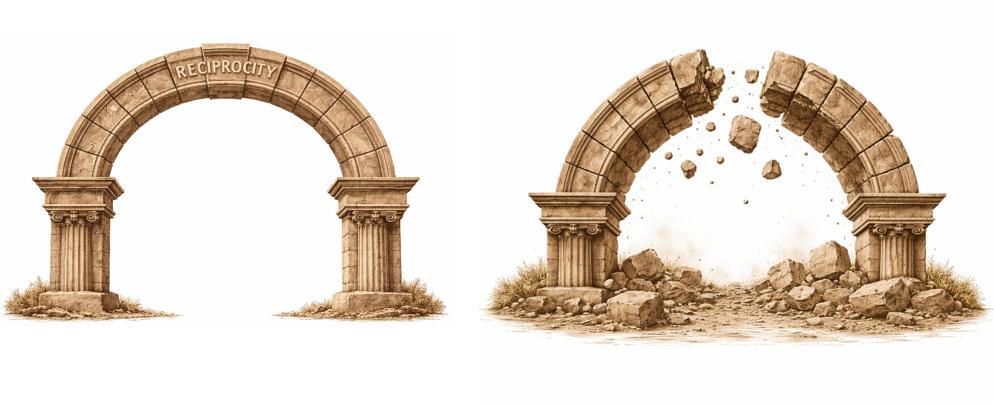
Contribution is the keystone of the relational arch. Remove the keystone, and the arch collapses.
Almost everyone finds it easier to respond to invitations than to make them. Responding offers full agency and convenience with little effort. Invitations, on the other hand, are signals of affection, interest, manners, and priority. A friend who never initiates reveals that they are unmotivated, indifferent, or simply not invested. Relationships without shared contribution are closer to charity than friendship.
In rare cases—illness, age, or crisis—you may choose to carry more current for a time. That’s generosity, not imbalance, as long as both partners still honor the flow.
New good friendships require balance and shared contribution. Most people flinch or bristle when they hear this. Friends don’t keep score. For some people, it’s uncomfortable to admit that they might be conserving energy at someone else’s expense. They think Friendology is asserting a numerical equality of effort; it’s not. When no one reaches out, there’s no heat. When one person carries the current, it can work, at a cost, until they stop. Then everyone wonders why it suddenly went dark.
I’m not telling you to keep score. I’m telling you your friend’s neural imprint is.
When you remove a friendship that no longer returns energy, the entire network brightens. Unhealthy friendships drain attention, emotion, and time without giving you much back; once cut, that energy redistributes and energizes among healthy connections. The friendship network, like every ecosystem, needs periodic clearing to grow and regenerate.
In Friendology terms, this is energy management. Reciprocity keeps the relationship charged; neglect drains it. When one founder of the friendship stops feeding it, the imprint weakens. When both stop, it dies.
V. What Is a Friend?
A friend likes and misses you enough to initiate contact and invite you to meet one-on-one. Those who don’t are Connections, Acquaintances, or Teammates.
Good friend – very high trust, very few boundaries
Friend – high trust, few boundaries
Casual Friend – medium trust, medium boundaries, fit a little off, those waning or plateaued
Connection – someone whose contact info you have and who has yours
Acquaintance – someone you know and interact with
Teammate – someone you meet and can contact but you always meet in a group or at work or place or doing an activity; they are not friends unless you have a personal relationship outside of the team or place.
Many people count place-friends as friends, but they are not the same. This will prove out if the coffee shop, gym, bar, company, or social club closes as you are unlikely to see them again. Friends meet personally in various settings with intent. The friend becomes the purpose of meeting, not the activity. The place and activity friends will mask the lack of personal friends. Remember, some old friends are just old.
Missing from the list of friend types above is Best Friend. A best friend is usually formed before adulthood and is one who keeps your system stable — the person whose presence re-centers you, recharges you, and grounds you. The imprint is so strong that it requires little maintenance and relights with little effort because so much already went into the encoding. Only 37% of people even report having one. If you do not have one, making 4 shared contribution local friends will be a strong surrogate source of resilience and stability.
Among people you like, successful Friendships are largely tactical and work best with many areas of fit and overlap. The key areas to look for fit are:
1. Time available to meet
2. Frequency other party is interested in meeting
3. Self-employed or working for someone will be a primary driver of schedule availability
4. Age can be correlated to lifestyle, like caring for kids or semi-retired or retired
5. Marital or partner status, 2 single people will have many opportunities to meet, while someone with a difficult or demanding spouse will have fewer
You are likely to have a better friendship with someone with a high tactical fit who you like well enough than someone you like more with a poor fit. Frequency drives affinity.
Happiness is both the seed and the soil of friendship. Without a little light inside, few will grow close enough to imprint. Joy is the magnet of friendship. It begins within but amplifies between. Without some happiness to offer, the dance rarely starts.
Loneliness can and should be a motivator to invest more in friend development, but it can be a struggle when people have no friends, confidence, confidants, or a framework for doing it. Friendology will transform understanding, approach, and results for building your chosen community of friends through connecting and imprinting.
VI. Finding Friends: Where Quality Connections Come From
Any of these sources can produce good results, but some are less and more likely to produce durable, healthy friendships.
Poor sources Explanation
1. Parents of kids’ friends no independent connection, unlikely to outlive graduation
2. Work friends transactional, most will fade after you leave company
3. Neighbors proximity, when they move away they will fade
4. Meetup attendees mostly people whose goal is activity, not friendship
5. Salespeople transactional focus
6. Restaurant employees transactional people you tip, they seem to like you
7. People at gym hard to bridge to outside the gym
8. Mentor/mentee asymmetric, overlapping function
9. Bars low quality and often not the healthiest people
10. More than 45 mins drive the driving could take more time than the outing
11. Online-only less valuable, easier to ghost, not much help in crisis
Better Quality Sources
1. Friends of friends people you like should have friends like them
2. Social clubs the paid subscription increases probability of sociality
3. Country clubs one of the benefits of membership
4. Friend finder apps expose you to a wider range of people than you can meet
5. Book clubs creates longer and deeper interaction
6. Potluck clubs proves out reciprocation and generosity
7. Hiking clubs creates a longer interaction and is outside in nature
8. Religious groups aligns values, prayer can be very connecting
9. Service clubs aligns values and interest and proactive types
10. Exercise groups that builds frequency, shared goals, experience, intensity meet regularly, like yoga, dancing
Move friendship development along by asking acquaintances for contact info, reach out and schedule, and be friendly. You have to do the work to find the people that fit.
VII. Future Research: The Contribution Hypothesis
The next hypothesis we are testing is that shared contribution is the single most accurate measure of the health of a friendship — and the most reliable predictor of its maintenance, strengthening, or inevitable decay.
Early signs show a consistent pattern across the entire lifespan of a friendship:
Initiation Phase: quick replies and timely pings are the earliest measurable signals of interest and bilateral energy.
Stabilization Phase: invitations to meet—especially one-on-one—become the central indicator of investment.
Maturity Phase: curiosity, empathy, emotional presence, and material generosity emerge as high-density contributing behaviors that keep the field alive and evolving.
Our emerging model suggests that no other behavior—individual or combined—shows stronger predictive power, causal influence, or correlation with the ongoing health of a friendship. Not imprint, not shared history, not compatibility, not personality traits. Shared contribution alone explains the majority of the variance.
VIII. Conclusion
Most people grow up believing friendship should just happen. But adult life makes one truth unavoidable: belonging is something you build. Not by waiting, not by hoping, but by understanding the mechanics of how friendships form, strengthen, and last.
You now know the three pillars:
Much stability can come from the lateral friend network.
Friends supply the renewable energy your nervous system actually runs on.Imprint is the friendship pattern between two people.
It’s the living neural space that lights up when someone matters.Reciprocity keeps the field alive.
Invitations, interest, and effort circulate warmth through the connection.
Healthy friendships aren’t accidents, they’re patterns you can recognize and patterns you can create. If your network is thin right now, it can be rebuilt. I did it from one local friend. Many people have done it from zero. Once you understand how the system works, progress is not slow or mysterious; it’s predictable and arduous, and it gets easier the more friends you establish in your base.
Start small. Meet two or three people who give you energy and show curiosity. Let frequency do its work. Notice who contributes to and energizes the relationships. Those are the ones worth investing in.
Now you have an opportunity to turn these three friendship principles into three or more new friends.
Erik