August 25, 2026
Develop Hobbies and Make Friends Before You Retire
Retirement can leave you with more free time and fewer people to spend it with. The hobbies and friendships that make those years rich can take much longer to build than most of us expect.
Retirement can give you something you have wanted for decades: free time and autonomy. No alarm, no commute, no meetings, no boss and no Monday morning. Then Tuesday comes. Then Wednesday. Nobody is expecting you anywhere. The people you used to talk to every day are at work. Lunch doesn't happen unless somebody arranges it. You have plenty of time, but increasingly fewer reasons to leave the house.
At first that freedom may feel wonderful. Then boredom can become drift. You stop doing as much because there isn't much you have to do. Your world gets smaller. The friends you do have are busy, move away, get sick or become less active. Work used to put new people in front of you automatically, but that source is gone. Now if you want someone new in your life, you have to go find them.
And that is when you can get stuck. You need more people and more things to do, but you have fewer natural ways to find either. Starting a hobby means walking into a room where you don't know anyone and being a beginner again. Making friends means meeting lots of people, tolerating bad fits and repeatedly putting yourself in unfamiliar situations. The longer you have been socially stalled, the harder all of that can feel. You can end up with enormous amounts of free time at exactly the moment when you have the least access to people with whom you want to spend it.
My 87-year-old mother has a simple piece of retirement advice:
“You should have a lot of friends and a lot of hobbies before you retire.”
The important word is before.
Why Start Years Before You Retire?
Because finding good hobbies is harder than it sounds. You don't need something that entertains you for an afternoon or something you enjoyed twice on vacation. You need two or three things you will still want to do on an ordinary Wednesday five years from now.
A retirement-grade hobby has to survive a surprisingly difficult set of tests. You have to genuinely enjoy it. You need reasonable access to it. You need to be able to afford it. Your body has to tolerate it. There needs to be enough challenge that you don't get bored, but not so much difficulty, preparation or stress that doing it becomes work. And some things that sound perfect are simply boring after you do them ten times.
You cannot figure this out by making a list of hobbies. You have to play. You may have to try ten or twenty activities to find two or three that really work for you. Then you have to become competent enough to enjoy them, find places and people to do them with and turn them into recurring parts of your life.
And for many retirement may be forced on us earlier than we had planned.
This is why “I'll find some hobbies when I retire” isn't much of a plan. Retirement is when you want to harvest the hobbies, not begin planting all of them.
Making Friends Can Take Even Longer Than Finding Hobbies
Making five good local friends outside of work is difficult too. You probably won't meet five people and make five friends. You may need to meet 50 or 100 people, spend more time with the promising ones, discover who fits, survive some disappointments and give the good relationships enough time to accumulate history.
Work can disguise this problem because it has been supplying people for decades. Coworkers, lunches, meetings and familiar faces create regular human contact without requiring much acquisition effort from you. Then retirement can remove much of that infrastructure in a single day.
A work friend may be a genuine friend, but retirement provides an interesting test: would you still see each other if neither of you worked there?
The job can also get harder if you wait too long. Somewhere in the pre-elder years, some people begin contracting. They stop trying new things. Familiar routines become easier. Their social acquisition muscles get less exercise. Then, when they finally need more people, the assignment can feel enormous.
Find a group. RSVP. Drive somewhere unfamiliar. Walk into a room full of strangers. Introduce yourself. Discover they're not your people. Go home. Then do it again.
That's a lot of homework for somebody who hasn't done the homework in 20 years.
Some Hobbies Are Better at Making Friends
A hobby doesn't have to be social to make retirement better. Reading, gardening alone or working on a project can give a day purpose and pleasure. But if you also want a hobby to help build your social life, some hobbies have much better friend edges than others.
Look for activities that bring you into contact with the same or overlapping people repeatedly. Repetition matters because friendship needs more than one good encounter. Smaller groups often help because people can actually get to know one another instead of repeatedly being surrounded by strangers.
The activity should also leave some attention available for the people. If everybody is concentrating intensely for two hours, you may have shared an experience without learning much about one another. A good social hobby gives everyone enough structure that nobody has to manufacture conversation, but leaves enough room for conversation to wander.
Skill development helps too. Getting better gives you a reason to return, something to talk about and eventually something you can help another person learn. Hobbies that actually require other people have another advantage: your desire to do the activity creates a recurring reason to maintain a network of people who do it.
Mahjong happens to do this unusually well. A few people around one table share a single activity. Games are short. Skill develops quickly. Conversation can continue during play. Nobody has to manufacture two hours of socializing because the game provides the container. And the physical game isn't much fun alone.
If you want to play Mahjong regularly, eventually you need people who play Mahjong.
Then something useful can happen. You stop going somewhere because you are trying to make friends. You start going because you want to play Mahjong. You see some of the same people again. Somebody brings a friend. You get better. Conversation continues. Relationships can develop without friendship itself becoming the assignment.
Golf is another strong example. Four people can spend several hours together, conversation fills the space between shots, skill gives you a reason to return and an enormous infrastructure of courses, leagues and regular foursomes already exists.
Other hobbies create their own social openings. Hiking can provide hours of conversation. Darts naturally rotates participation. A book group creates recurring discussion. Skiing may produce its best conversation over lunch. Singing in a choir creates repeated contact through a shared skill.
So don't only ask:
Do I like doing this?
Also ask:
Who does this keep putting in my life?
Now for the Fun Part
This may sound like a lot of work. It doesn't have to feel that way. Give yourself years to experiment. There are hundreds of things you might discover you love.
Here are some places to start.
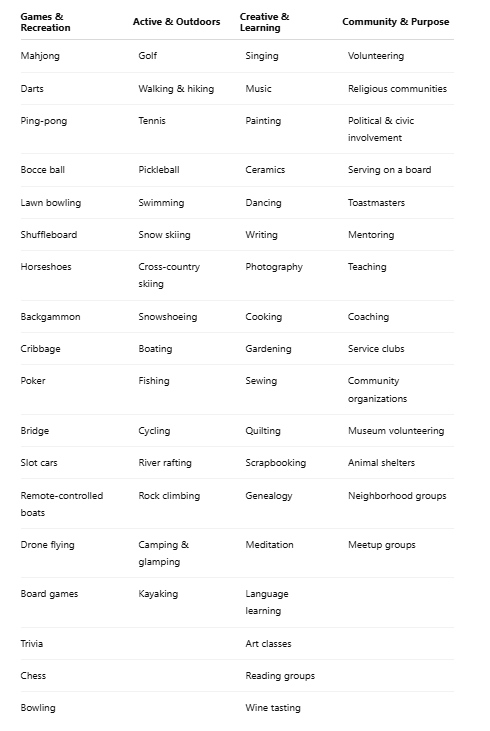
You don't have to love everything on this list. You need to find two or three things that make you look forward to Tuesday, and a handful of people you're happy to see when you get there.
You may need to try 7 to find three that work for you.
Give Yourself Seven Years
Seven years isn't a scientific number. It is a practical amount of runway to try hobbies, get good enough at the ones you enjoy, find communities around them, meet a lot of people and allow a small number of those people to become real friends. When you have years, a hobby you abandon or a friendship that doesn't develop isn't a failure. It is sorting.
Having hobbies will enrich your life no matter when you start. On their deathbed no one says: "I wish I had spent more time at the office."
By the time you retire, I think you should aim to have five good local friends who don't depend on work and two or three social hobbies or recurring groups that you genuinely enjoy. Just as importantly, keep the practiced ability to add new people and try new things. Friends move. People get sick. Groups dissolve. Bodies change. Hobbies stop being fun.
Loneliness is a lagging indicator. Don't wait for it to tell you that your social system needed work years ago.
My mother's advice sounds simple because she compressed the hard part into one sentence: have a lot of friends and a lot of hobbies before you retire.
The Tuesday after you retire is coming either way.
Give yourself seven years to make sure you have somewhere you want to go and people you're happy to find there.